Left handed reliever Matt Strahm had knee surgery.
The Athletics are interviewing guys for their GM vacancy. We’re talking Mike Rizzo and Billy Owens here, not Perry Minasian.
Photo credit: Rex Fregosi
Left handed reliever Matt Strahm had knee surgery.
The Athletics are interviewing guys for their GM vacancy. We’re talking Mike Rizzo and Billy Owens here, not Perry Minasian.
Photo credit: Rex Fregosi
Angels might lose 100 games and still not have the worst record (thanks a lot Rockies)
The only saving grace:
Colorado plays 10 of their final 13 games at home, where they have a much better record than away (opponents are SD, AZ, and SEA).
Their final 3 games are on the road vs. the White Sox, who COULD be resting some guys if they clinch a playoff spot (albeit, an unlikely scenario)

Rockies 55-94
Angels 56-93
Athletics 61-89
Giants 62-88
Rockies will most likely beat us out for last. Now if the Giants can finish with a worse record than the A’s that would juice our lottery odds a little more!
White Sox 76-73
Guardians 76-74
Blue Jays 75-75
Operation get Jo and Sori in the playoffs is getting closer 👀👀👀
The Angels payroll in 2026 is around $160 million. My thought is IF whoever controls the purse strings wants to stay around the same number, the committed to include “estimated” arb salaries is around $84 million. So my thought is for only one/max 2 year, you COULD add 7 – $10 million players or 14 – $5 million players. Out of them, MAYBE 3 or 4 play or pitch better than this year. None will be on their way to the Hall of Fame except to buy a ticket.
(And there are certainly NOT 15 of the younger FAs worth a flip) Again, I am looking at “competitive” and not “winning it all.” And other teams will be trying to do similar, so maybe 4- 5 total would be all that would be willing to come to the Angels.
Let’s take quick review of our trade deadline. The numbers are reflective since being traded —
Jose Soriano: 40 innings, 4.05 ERA, 1.38 WHIP
Arjun Nimmala: .260 / .389 / .577, 8 HR
Jo Adell: .239 / .316 / .418
Jacob Cozart: .248 / .356 / .475
Ryan Zeferjahn: 13.1 innings, 6.08 ERA, 1.5 WHIP
Moises Ballesteros: .205 / .256 / .311
Chase Silseth: 15.1 innings, 5.28 ERA, 1.63 WHIP
Logan O’Hoppe: .353 / .333 / .412
Angel Arredondo: .283 / .383 / .391
Turks already covered Soriano/Nimmala. Early returns are looking like a big W for Moz.
Adell is hitting slightly above average for Cleveland and looks to be on his way to the postseason! Cozart has played a significant role himself getting Rocket City to the playoffs.
Zeferjahn has been a gascan for Chicago. Mo Baller is turning it this month .333 / .371 / .667 w/ 3 HR and looks passable behind the plate.
Silseth has regressed as his peripherals suggested he would and O’Hoppe is back in AAA. There were a few on here who lost their minds at this trade 😂.
O’Hoppe’s BA being higher than his OBP is funny

How is that even possible?
Ahhh sacrifice flies apparently.
ya it’s a weird one.
Basically Batting average is based on at bats, whereas OBP is based on plate appearances

Arjun Nimmala topped this week’s prospect hotsheet at Baseball America as the hottest prospect in the minor leagues. Kid got his face on the homepage cover and everything.
7 HRs in your last 10 games (leading all AA hitters in September) will do that.
Team: Double-A Rocket City (Southern)
Age: 20
Why He’s Here: .417/.440/1.083 (10-for-24), 7 R, 4 2B, 0 3B, 4 HR, 6 RBIs, 0 BB, 5 SO
Nice to see such strong early returns from the Soriano trade, which received some mixed reviews from CtPG among folks who weren’t so hot on Nimmala. Well, adjust your expectations, lads, he’s paying off. They’re sending him to the Arizona Fall League next month, and as we know, the AFL is something of a finishing school for advanced prospects. Dudes that perform well there tend to make their MLB debuts the following season.
Jose Soriano, btw, has been, in a word, serviceable for the Jays since the trade. 4.05 ERA / 4.33 FIP. K rate has fallen to 6.1 per 9. I think Moz should be pleased with the current outlook on his exchange.

Cool. It will be even better if we can get Eddie Micheletti and Angel Rivero cookin. Both have had a rough go of it. But if Nimmala continues to rake, that is plenty enough for me.
Haha, you may getting a little greedy. 🙂 Micheletti was an unranked org guy on the very fringes of Toronto’s system – if you’re expecting impact, you’re likely to be disappointed. He didn’t even make the tail end of the Fangraphs offseason report, and got a cautionary mention in the notes (“Micheletti had the type of season that usually prompts questions in the comments. He has above-average thump and a good eye, but everything else is light.”) Maybe he finds an up and down bench role down the line?
Rivero is a teenager just coming off the complex. Giving him a cup of coffee in peak heat summer in the offensive-oriented Cal League was just a taste for him – I really wouldn’t read much into the results. Lottery ticket with a long payoff horizon.
The Soriano trade was about Nimmala, and if you can’t get excited about trading two years of decent pitcher who is ripe for regression for six years of a 30 HR+ shortstop with an above-average glove, it may be hard to excite you. 🙂
The eye test is strong for Nimmala too. Consistent loud contact and power to all fields is tantalizing
I’ve been very open that I wasn’t the biggest fan of this trade, mostly because I’m just not as high on Nimmala.
He definitely hits the ball hard when he makes contact. If he can improve contact rates (especially against breaking balls) then we definitely have something
I remain a little surprised that your read of Nimmala is so agnostic of where he sits on the age curve.
20 year olds in AA with Nimmala’s contact quality, power output and lack of chase are very rare. There is likely always to be an element of whiff in his game, but he also is a very selective hitter for how young he is. He’s pacing first rounders from power conferences who are 2-3 years his senior at the moment.
I keep having to remind myself that he’s so young
I’m coming around on him for sure, was just saying in the moment I wasn’t as big a fan
I’m thinking a trip to the AFL might be warranted this season. Getting an up close look a Nimmala would be cool and I’m confident I could get a media credential.
Let’s see if I can find a road trip partner.
i volunteer as tribute
Sweet.
As a chronic complainer I have to post a compliment to the FO. On MLB Traders Rumors, going back to September 1st, they announced the sale by Arte. Since that date, there is a notice that Shaun Anderson signed a minor league contract. (Insert Big Yawn).
Multiple teams have DFAd multiple players getting ready for the playoffs and the FO has passed on everyone. I love they are keeping their powder dry. None of the ones that I have seen would be with the team next season anyway. Play the kids……….

It’s going to be absolutely hilarious watching the collective meltdown around here if Suzuki isn’t fired.
To be clear, I’m not arguing that he should be retained. I honestly don’t know. I haven’t watched enough games, and I’m not nearly qualified enough to break down the finer points of managerial performance beyond the obvious things everyone sees.
What cracks me up is the number of people treating his firing as a foregone conclusion. You’d think the announcement had already been written and all that’s left is for someone to hit “send.”
Maybe Suzuki gets fired the day after the season ends. Maybe he doesn’t. But if the current ownership decides to punt the decision to the incoming owners and Suzuki is still in the dugout when spring training rolls around, the outrage around here is going to be spectacular. Honestly, the reaction might end up being more entertaining than the baseball itself.

His contract runs out after the season. He won’t be fired, he just might not get a contract renewal.
True. Forgot about that aspect.
I think that Suzuki treats his grandma nice, is friendly to his neighbors, and doesn’t beat the family dog. But I don’t understand his managerial decisions.
Just one example, the games with DC. A Nats runner took his time coming home and scored. But there was a play at second and had that runner been out, the run would not have counted. As the runner came into the dugout, their manager grabbed him by the arm and talked to him. I have no idea what was said, and it didn’t appear the manager will yelling. But it also appeared that the runner wasn’t thinking about the play at second. That is what a manager does with a young team. Not sit in the corner and just watch the game. At least, in my opinion.
Suzuki isn’t returning lol. There’s literally 0 chance of it happening.
I prefer he is not rehired but the Athletic article by Rosenthal/Blum touches on an important point that the new ownership won’t finalize until late Spring and the lockout just might be enough for them to stay with status quo. Lol, also reportedly as the article alludes to…Kurt has rubbed Mozeliak pretty well as John speaks highly of Kurt. Stranger shit has happened.
What I don’t want, is another 1-year contract for anyone. Angels need to hire a guy to be put in place for years to help oversee the rebuild. That would eliminate Kurt for me.

I think Kurt hangs around till the next GM decides on a manager.
It looks like Moz thinks Kurt is ok as a manager. Which should scare us all.

Suzuki won’t even call out bad play or plays from his own players, moz isn’t going to come out and trash the coach leaving in a few weeks.
Moz wouldn’t have to trash publicly. Just say these are the players you will write into lineups. If you don’t like it then walk away. I’m extremely disappointed that Moz did not force Kurt who to play. Easy to see how much of an idiot Kurt is.
Lol, he’s gone.

Two weeks to go
Two more weeks for Zuk. He should be gone in 14 days.
Mike needs 0.4 bWAR to catch Jimmie Foxx for #29th best Position Player in history.
Go 7-6 at least.
That’s it.
The caption to the photo.
Manfred: “Do you like playing for the Dodgers?”
Trout: “We are the Angels.”

I find it fascinating how so many of the greatest hitters like MNT keep their hitting approach so simple. The Votto and Tony Gwynn analytical types seem to be the exception and not the norm. Also the huge majority of them think be on time for the fastball – react to off speed – and they try not guess too much. One exception was Kevin Mitchell who said he sat breaking ball and reacted to fastball – but most are in awe he could do that. I had Claude analyze the Talk Hitting articles and come up with some summaries. Here’s what it wrote.
What 100+ Big-League Hitters and Coaches Actually Say About Hitting: A Synthesis of FanGraphs’ “Talks Hitting” SeriesTL;DR
Key Findings
Details1. Consensus principles — the advice nearly everyone gives“Keep it simple” is the closest thing to a universal creed. It is voiced explicitly by Mike Trout (“for me, it’s about keeping it simple… if I overevaluate things… bad things happen”), Jacob Berry (whose interview is literally titled “Believes in Keeping It Simple”), Marcelo Mayer (“a simple approach and a high ceiling”), Trevor Story (“likes to keep hitting simple”), Matt Vierling (“keeps hitting simple”), Bobby Witt Jr. (“I try to have it as simple as possible”), and Edgar Martinez (“the simpler it is – the simpler the mechanics – the better your chance are of hitting a fastball”). This is the most-repeated single idea in the series.
Be on time for the fastball, react to the offspeed. Trout states the archetype: “I’m always looking for one pitch. I’m looking for a fastball. If I’m on time for the heater, I can react to the offspeed.” This “fastball-timing, adjust-down-to-offspeed” logic is the default operating system for a large share of interviewees.
Hit to your strength / don’t chase your weakness. Trout: “If you’re not hitting to your strength, there’s an issue.” Eric Hosmer built an entire career-defining decision around it, concluding he needed to “stick to my natural swing” rather than chase loft that “just didn’t shape out well for me.”
Stay up the middle / use the whole field. Trout describes staying “up the middle to right-center” and “moving my sights” to fix timing. Joey Votto reworked his whole approach to “spread the ball all over the field” to beat the shift. Triston Casas wants to “use the whole field and hit the ball to the opposite field a lot.” Drew Saylor coaches hitters toward “hard line drives up the middle.”
Swing decisions are the foundation. This is the organizing principle for the more modern voices: Orioles coach Ryan Fuller (“what we believe in starts with making great swing decisions”), Blue Jays’ Hunter Mense (interview titled “On Developing Good Swing Decisions”), and Alex Bregman (“hitters with really good swing decisions” are the differentiator).
2. Philosophical campsFeel/instinct vs. data/mechanics. This is the spine of the whole series.
Lower-half/ground-up vs. hands/contact-point thinkers.
“Same approach every at-bat” vs. “bucket pitchers by arsenal.” This is the cleanest direct contrast in the series, and Laurila engineered it:
Line-drive/contact vs. loft/launch-angle.
A useful nuance for a coach: several hitters explicitly warn that chasing launch angle can backfire. Kwan’s coaches kept “the bumpers on” his contact skills; Hosmer’s power experiment failed; Nootbaar admits creating loft “is a challenge… it takes a lot of work in the cage.”
3. Adjustment triggers — what tells a hitter something’s off, and how they fix it
4. Handling being pitched toTrout is the archetype of a star with a known hole (elevated fastballs) who refuses to chase it rather than trying to cover it: “I know that they’re going to throw me fastballs up. If I’m in a good spot at the plate, I won’t swing at that ball up… I will lay off the ones up and hit the ones down hard.” A FanGraphs commenter’s data in the Trout piece quantified just how extreme his low-ball preference is (roughly .672 production high vs. ~1.01 low on competitive pitches — illustrative reader analysis, not editorial).
Contrast the responses:
The practical lesson: elite hitters either (a) discipline themselves not to chase the hole (Trout, Bregman, Walker) or (b) do dedicated cage work to neutralize it (Votto). Almost none pretend the hole isn’t there.
5. Use of analytics and technologyThe series runs a full spectrum:
The near-universal caveat is “don’t be a robot.” Trout: “if you’re trying to be a robot up there, trying to get a chart to be exactly the way you want it, that can get you in trouble.” Even the nerds agree: Walker credits his coaches with keeping him “competitive and less mechanical.”
6. Coach vs. player perspectiveThe coaches are strikingly consistent with one another and distinct from players: where a player describes his method, a coach describes a system for many methods.
The gap between coach and player framing is the report’s most coach-friendly finding: players give you their answer; coaches give you a way to find each hitter’s answer.
7. Quotable swipe file (each under ~20 words)
Recommendations (for any hitter or coach looking to improve)
Caveats and AppendixSourcing caveats. FanGraphs shows a membership paywall mid-article to non-members, so for many interviews the synthesis works from the substantial free lead sections plus extended search-indexed excerpts rather than full transcripts. Quotes reproduced above appear verbatim in those accessible excerpts; where a thesis is summarized without quotation marks, treat it as paraphrase. Career stats and roles cited (e.g., Trout’s 163 wRC+ and 90.2 WAR, Burger’s 107 wRC+, Kwan’s 118 wRC+) are from the interviews’ own framing as of their publication dates and are not updated to present day. The Trout interview’s high/low production-split figures come from a reader comment, not FanGraphs editorial, and should be treated as illustrative only. Votto’s “holy book” quote about Ted Williams’ The Science of Hitting comes from a 2026 ESPN feature, not the “Talks Hitting” interview itself.
Interviews read in full or substantial part: Mike Trout, Jake Burger, Joey Votto, Bryce Harper, Triston Casas, Christian Walker, Josh VanMeter, Eric Hosmer, Steven Kwan, Lars Nootbaar, Logan O’Hoppe, Ryan Fuller, Edgar Martinez, Donnie Ecker, Spencer Steer, Thomas Saggese, Alex Bregman, Jo Adell, Robert Van Scoyoc.
Interviews confirmed via targeted follow-up (thesis + one quote each): Charlie Blackmon, Doug Latta, Dave Magadan, Don Mattingly, Paul Molitor, Mark Loretta, Tim Hyers, Drew Saylor, Bobby Witt Jr., Nelson Cruz.
Interviews on the master list not individually accessed (covered only by inference from the series’ patterns; not quoted): Jeff Albert, Greg Allen, Pete Alonso, Nolan Arenado, Aaron Bates, Jacob Berry, Bo Bichette, Justice Bigbie, Cavan Biggio, JJ Bleday, Bobby Bradley, Will Brennan, Jay Bruce, Matt Chapman, Michael Chavis, Max Clark, Garrett Cooper, Gavin Cross, Jacob Cruz, Paul DeJong, Brenton Del Chiaro, Josh Donaldson, Brendan Donovan, Rick Eckstein, Drew Ferguson, Justin Foscue, Michael Fransoso, Joey Gallo, Paul Goldschmidt, Devlin Granberg, Gino Groover, Matt Hague, Andy Haines, Mitch Haniger, Robert Hassell III, Austin Hays, Nico Hoerner, Jackson Holliday, Spencer Horwitz, Rhys Hoskins, Jacob Hurtubise, Walker Jenkins, Connor Joe, Jace Jung, Josh Jung, Jimmy Kerr, Heston Kjerstad, Shea Langeliers, Trevor Larnach, Dillon Lawson, Brooks Lee, Royce Lewis, Evan Longoria, Joey Loperfido, Michael Lorenzen, Gavin Lux, Trey Mancini, Marcelo Mayer, Kevin McGonigle, Hunter Mense, Owen Miller, Colson Montgomery, Tre’ Morgan, Ryan Mountcastle, Cedric Mullins, Daniel Murphy, Vinnie Pasquantino, Graham Pauley, David Peralta, Luke Raley, Julio Rodríguez, Brent Rooker, Anthony Santander, Nolan Schanuel, Marcus Semien, Giancarlo Stanton, Trevor Story, Fernando Tatis Jr., James Tibbs III, Spencer Torkelson, Mark Trumbo, Brice Turang, Justin Turner, Trea Turner, Chris Valaika, Zac Veen, Alex Verdugo, Mark Vientos, Matt Vierling, Luke Voit, Anthony Volpe, Ryan Waldschmidt, Jared Walsh, Jordan Westburg, Jesse Winker, Mike Yastrzemski, Nick Yorke, Kevin Youkilis.
Notable contradictions / prospect-vs-veteran differences.
Maybe next time write a fanpost instead of a comment when it is this long.
Will do.
I love Claude. I would be interested in a comparison of this Claude response with Claude summarizing Ted Williams hitting philosophies.
I was actually going to have it go a lot deeper – that’s a good idea.
This aligns with what I remember from interviewing Mike 10 years ago.
Same approach every at bat. And f* launch angle.

Sigh. I wish Joey Votto had been a Yankee so they’d put him in the Hall of Fame.
Tank keep on rollin tank rollin blues. Roll on tank roll on.
We may not be able to hold off the Rockies as ultimate tank commander. They are pretty bad and wind up the season against better teams. We will have to see….
I watched Bryce Harper play this weekend, thought about Mike Trout, and got sad. They are, to a large extent, having very similar seasons. But because Harper, to his credit I think, sets and states personal goals, meets them, is a leader on a good team, etc he gets a lot of credit for a 4 WAR year. Trout is a shitty CF who Ks too much. I hope he can really make the DH adjustment. That he just comes out and says “I’ve been working on becoming a cold professional hitter all off season and I intend to be Edgar Martinez with power going forward.” I bet he could do it and have a somewhat “monster” season. Get that BA up a little, hit a few more HR and strike out a little less, get that OPS+ above 145. The difference between him and Harper at this point is basically jus perception. He’ll be the toast of the talking heads again with just a little better season.
Watching the Angels lose more close games because they can’t hit for shit has made me consider free agent options. Of course, if they do something smart like trade Neto there’d be no point, but if they don’t maybe they should try to sign a bat. People are saying Brandon Lowe but he’s gonna get the QO, or at least the Pirate fans are all talking that way. The Angels need a couple young bats like Guzman to pick it up next year AND likely a new 700+ OPS hitter along with Neto, Nolan and Trout and the young pitching to make .500. Maybe Mo Baller can help?
Sigh…. at least TJ Watt is still cool.
Normally I want to sign the best FAs every year. Every year.
Not this year though. No one I want. We definitely need some bats but the answer is not in the Market
The market sucks pretty bad. I still think they should just trade Neto and Detmers, hire lots of scouts and coaching, and finish the rebuild for real. But if they went ahead and declared they are “almost almost a winner and also old men need someone to watch.” then they need to sign a middling guy investment wise who will just boost their offense a bit…. nothing splashy.
We’ve been calling for a complete rebuild for quite a while. Certainly the bullpen needs help and there needs to be more offense. But the SP has come along the last 4-5 weeks with new coaching(?) I’m not so much in the “sell” cam as I was especially if there’s some chance of signing Detmers and Neto to cheaper extensions. I think with so position holes to fill this team is on the upswing in the next two years. Neto and Detmers are players to start building around, and they’re pretty cheap in the meantime.
Fwiw, Neto’s value keeps a-risin’ in the BTV sim as he sees his late season resurgence. You can get all sorts of fun stuff in your Xmas stocking for him these days.
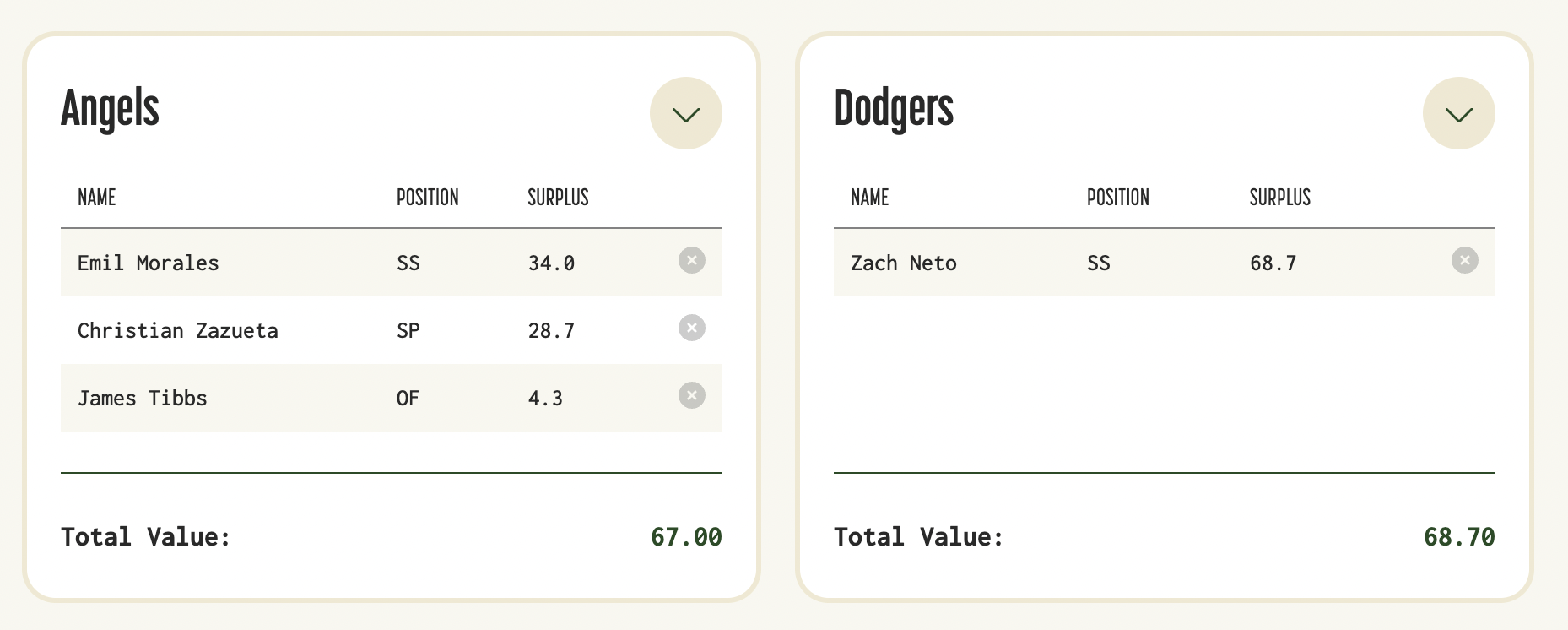
Nothing stands out to me as well on a long term deal. I think the backdrop of now having a thick wallet has me thinking you could sign a 1-2 year bat as the team is building at the same time. Angels need help almost everywhere on the diamond
Have you not received the memo that we aren’t allowed to criticize Trout because of what he did in the 2010s?
I thought his BA would sink to the .220s so kudos to him for keeping it above .240.

They were talking on the latest Halo Territory with Sam Blum about the possibility of Suzuki staying on next season. God help us.
If Zuk isn’t gone in 14 days, I hope Moz is gone in 15 days.
It’s the only important off-season decision.
I will. Laugh. Hard.

The players are not buying the narratives that certain franchises/owners are at risk financially if there is not a cap. The value of the franchises – even the most penny pinching and poorly performing – are too high to accept that narrative. There is no bankruptcy risk – an owner can just sell his/her franchise for $1 billion+ to a new ownership group.
Also with current revenue sharing, the chances of a franchise not being able to pay its bills is zero.
That leaves the owners without the bankruptcy narrative that existed in the 1970s-1990s leading to salary caps in the NFL, NBA and NHL.
So what is the strongest argument in MLB for a salary cap and parity? It has to do with fans of lower level clubs losing interest in the losing franchises leading to a concentration of interest/participation in only a few clubs. There is generational risk that losing clubs will generate little sustainable interest in the future.
As an example – the Angels are still benefitting from their magical decade starting with the WS championship in 2002. Children born in Southern California in the late 1980s to early 2009s experienced that success and fanship was imprinted on them. My two girls are examples and are and will be lifelong fans. But what about children born in the last 15 years? Some will adopt their parents allegiance but vast numbers will not become fans due to the lack of Angels success/relevance. That is the long term risk to franchises who are bad for decades.
For a healthy league to exist there needs to be regenerative fan engagement throughout generations for all of the existing franchises. Without it, there is a long term risk that a team might be okay financially but have no engagement in its community. That is the risk of a league without parity. .
The problem is this is an amorphous risk and not really a financial one. Players are unlikely to buy into generational risk as a reason to accept a salary cap. As long as the money is there, owners are financially sound and the value of franchises increase, they don’t see a problem. But the risk of a handful of franchises potentially generating 85% of fan attention/engagement is a real problem for the league and that is where the battle ground exists.
First, I want to watch MLB Baseball next Spring.
Second, it is hard to choose sides in an argument between billionaires and millionaires as to how much money millionaires should get.
It’s not a hard decision for me. The owners don’t have a cap on what they can make. The players produce the value by putting a product on the field; they generate the uncapped value that the owners take in. Why should the value-producers have their salary capped when the ones who benefit from their labor don’t?
Because that is how you have a healthy league. Look at the NFL, NHL and NBA not to mention other sports leagues around the World. The focus is parity so that the fans in one community within the League have as much opportunity to root for a winning franchise as any other franchise in the League. Otherwise the generational interest pools in a few successful franchises. Basically the cap and floor would help to create parity within a League that is becoming more and more disparate in terms of resources and talent.
In many ways focusing on money clouds the issue because, as Texan44 says, it’s billionaires and millionaires fighting with each other. That makes it easy to say that if the billionaires have to pay the millionaires more – who cares? As long as we can drink beer and eat peanuts. The better focus is the long term health of the League and generational interest not pooling in 6-8 franchises.
It’s just principle for me. Baseball has a super long and interesting labor history. Having a floor would be my preferred option. Cap is unnecessary and won’t happen. The owners need to stop playing poor and pony up to be competitive.
I think this misses the point but I respect all opinions.
I totally get your point and I appreciate it and respect it. I totally get where you and others are coming from. It’s just for me, out of principle, I don’t support a cap. I don’t think it’s just.
I think we have two distinctions without a difference. I don’t think the salary cap does anything for parity. (I could be wrong and normally am.) But a strong commissioner could pool the revenue and then the cap would lead to parity. The key phrase is “strong commissioner.”
The cap and floor (emphasis on the latter) would definitely create parity. The delta between the highest and lowest spending teams would shrink dramatically.
On the surface, that seems like the bigger issue: the salary floor. If the league wants to address competitive balance, it should require teams to meet a minimum spending threshold rather than focusing solely on a salary cap.
Sorry, I don’t see how that would happen. Teams with their own networks that don’t have to share certain revenue would always have more to spend. Even with a cap if I can buy three players to your one I probably win out in the long run.
But if there is a floor and a cap, the difference between spending will be much reduced. For example, if the cap is $275 million and the floor is $190 million, there will not be one team spending $600 million and other teams spending $90 million. The maximum the spending gap will be is around $80 million creating parity.
As an example, with a cap, the Dodgers would be prohibited from having a payroll over that cap. At the same time, the team like.the Cleveland Indians could not have a payroll of $70m – they would be forced to spend up to the floor.
As a result, from the spending side, there would be a substantial increase in parity. There will always be better run organizations with better drafting and development of players, and that certainly comes into play. But the difference between the haves and the have-nots in terms of spending will be much reduced which should impact parity.
With 13 games to go; Rockies ahead by one for extra pin pong balls. Finishing 7-6 means 99 loses. Otherwise, it’s a 2026 typical September morning.