If you’ve spent any time watching baseball or high-level softball lately, you’ve noticed a jarring shift. The scoreboards are filled with triple-digit heaters and “sword” strikeouts, while batting averages are cratering to historic lows.
While the talking heads blame “the shift” or “launch angle,” the truth is far more calculated. We are living through what “baseball scientist” Perry Husband predicted years ago: The Hitting Apocalypse.
From Hitting Coach to Timing Scientist
Interestingly, Perry Husband didn’t start out as a pitching guru. He began his career as a hitting coach, but the more he taught, the more he realized that no matter how perfect a hitter’s mechanics were, they were consistently being dismantled by something they couldn’t control: Timing.
Husband watched what elite pitchers were able to do—often without even realizing it—and saw that they were manipulating a hitter’s reaction time by simply changing the location of the ball. This realization shifted his entire training philosophy. He stopped focusing solely on the “perfect swing” and began decoding the Science of Timing, leading to the birth of Effective Velocity (EV).
What is Effective Velocity?
EV is essentially Location-Adjusted Speed. Because a hitter has to reach further out in front to hit an inside pitch and let an outside pitch travel deeper, their reaction time is forced to change.
- The “Up and In” Speed-up: A 95 mph pitch up and in feels like 98–100 mph because you have to hit it so much sooner.
- The “Down and Away” Slow-down: That same 95 mph pitch down and away feels like 90–92 mph because you have more time to see it.
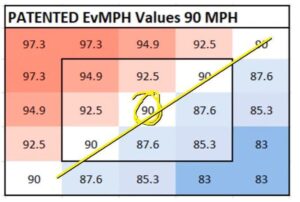
By alternating these locations, a pitcher can throw the exact same speed on the radar gun but change the “Effective Velocity” by nearly 10 mph. Husband discovered that if a pitcher stays outside a 6-mph “timing tunnel,” the hitter’s brain literally cannot adjust in time.
Pitchers view of a left handed hitter. 90mph pitch based on different locations.
The Carlos Pena & Mike Trout Prophecies
To understand how bold Husband’s claims were, look at his work with former MLB All-Star Carlos Pena. Pena has publicly credited Husband for his success, notably in 2009 when he tied for the American League lead in home runs. Pena often refers to himself as a “Jedi student” of Husband’s EV concepts. He has credited Husband with helping him achieve 100/100—100% mechanical efficiency paired with 100% perfect timing—allowing him to “hunt” a pitcher’s best pitches by understanding their true reactionary speed.
Years ago, when Mike Trout was virtually untouchable, Husband used these same EV goggles to point out a glaring mathematical hole. He predicted that if pitchers attacked Trout with specific sequences—specifically “up and in” to “speed up” his internal clock—his numbers would drop significantly. As teams began implementing these sequencing flows, even a superstar like Trout saw his elite production challenged by the simple math of timing.
Why the “Launch Angle Guys” Got It Wrong
Husband’s biggest beef with modern hitting is the obsession with launch angle. He argues that by trying to swing “up” to create home runs, hitters actually shrunk their own margin for error.
His theory is built on Squareness:
- The Perfect Path: Your bat should be on the same plane as the pitch’s descent.
- Square is the Goal: If you aim for square contact, a “miss” down is a backspun line drive, and a “miss” up is a hard grounder. Both keep your average high.
- The Home Run Trap: Husband calls home runs “beautiful accidents.” If you aim for a home run angle, your “misses” become lazy flyouts. You’re trading a high batting average for an “all-or-nothing” swing that requires perfect timing—exactly what EV sequencing is designed to destroy.
The Oklahoma Connection: Not Just for the Boys
This isn’t just a baseball phenomenon. One of Husband’s biggest proponents is the University of Oklahoma Softball dynasty. Under Patty Gasso, the Sooners have become a historic juggernaut by embracing the “100/100” philosophy.
The Sooners use EV to decode opposing pitchers, identifying which speeds and locations they can realistically cover at max efficiency. As Oklahoma hitting coach JT Gasso noted, working with Husband provided their hitters with a complete understanding of how to hunt pitches, essentially allowing them to “down-time” pitchers and neutralize their speed.
They Laughed—Until He Was Right
When Perry Husband first started preaching that the “radar gun was a lie” and that pitchers could mathematically shut down the world’s best hitters by manipulating a few inches of plate location, many in the traditional baseball world laughed. To the old school, hitting was about “grit” and “eye,” not “reactionary science” and “perceived velocity.”
But as batting averages across the league have plummeted to levels not seen since the 1960s, and as the pitchers who follow his sequencing flows become unhittable, nobody is laughing anymore. Perry Husband predicted the exact “Apocalypse” we are seeing today. He saw the end of the high-average hitter coming before anyone else—and it turns out, he was right all along.
Photo credit: Rex Fregosi





























Awesome and brilliant read, well done research and informative. I’ve thought that launch angle was just nonsense for years as it never made any sense except help the pitcher by creating strikes and a HR every 25-30 AB if lucky. Why has everyone who thinks they know batting techniques so anti ground ball? Because groundballs are singles unless hit down the line. Getting on base means little because it takes work to learn the K zone and singles everyone has been taught don’t produce runs. Oh, and RBI hold very little value. Throw the bean counters and analytic guys out of the stadium and return to real baseball of hit and run.
Nice job Halos Fan For Life. I’m going to have my son read this. I have been commenting that the whole launch angle (Look , it’s hitting science because it is right here on my iPad) trend has made The Angels players worse hitters and when they do actually hit a home run, the bases are usually a barren ghost town.
Get off your A swings with 8-15 degrees is the goal – basically barreled but no backspin (even though you want back spin – lol.) Two zones off either way is still good numbers. But because so few balls are hit square – you have margin for error missing high or low. Basically – hit the ball hard.
By the way – they all say “don’t hit ground balls, ground balls are outs.” But 44% of balls in play are ground balls. Ground balls are not outs. Soft ground balls are outs.
There’s so much cool data on hitting it hard and getting an A-swing – or from a pitching standpoint – stopping guys from getting A-swings. (Trout up and in)
By the way – EV – unfortunately is both Exit Velocity and Effective Velocity. So you have to decipher the meaning of which one they are talking about. Confusing for sure.
Fun read!
Great article!
Question – why is EV higher for pitches up high and lower for pitches low?
Great question. The way that helped me think about it is where do I need to hit the ball to have my A swing based on location. So low and in is neutral, because they don’t have to catch it as far out front and they aren’t having to create the space like you do for the up and in. Low and away you can catch it quite deep so you have even more time and that’s why it even feels slower than the fastball down the middle. Up and out is neutral. The modern swing was designed to still do damage on the low and away pitch – where old timers would take it the other way. That’s what is making them more susceptible to EV sequences. 95 fastball up and in feels like 100. Follow that with 85 slider away and you’re talking 80 – with 20 mph swing. To get an A swing on up and in – you have to really go early to get the barrel around in time. Most guys are late and have to cheat the swing and it’s why most hitters have lower exit velocity on up and in. The key to the EV concept is getting off your A swing where you can do damage. When he shows the stats on hard ground balls – they still are high average.
This is a fantastic article, thank you.
I love to review baseball stats – team & league wide. It’s usually one of the last things I do before closing my laptop for the evening. Anyway, the plummeting batting averages have bothered/perplexed me for some time. By the end of the year, there will be 10 players at most that are batting .300+ as the past number of years has demonstrated, which is sad.
Home runs are great, obviously, but the game has devolved as a result due to higher strike out rates and relatively low batting averages. I generally prefer line drive hitters that rope many doubles, have high batting averages and still have above average HR power. Those types are becoming a rare breed indeed.
I’ve assumed that the focus on “launch angle” + seemingly greater “velo” from more pitchers were the culprits for the general decline in batting averages, but, this piece provides new information. At least for me.
Again, thanks.
Yeah, but…
https://youtu.be/DpvfnEHdAvs?si=6xJzUF94oS0DOQMw
My favorite ad of all time.
If you want a longer explanation – and have some time (LOL) – this will give you the first level overview.
https://www.youtube.com/watch?v=tVIvGzb_YKY
If you want a shorter version- here’s Carlos Pena talking about it.
https://www.youtube.com/watch?v=9ZaJ1_b1048
A few years ago, when the Rangers played the D-Backs in the World Series – he had been consulting one teams hitting strategies and one teams pitching and had to bow out. If you add in the higher velos with better pitch sequencing – he was right when he predicted this drop several years ago. It’s fascinating stuff.
Contact baseball is so much better to watch over high k/few HR games. Same with the nba and their 3’s or nothing play, it’s not s good product to watch.
What a great read! Thanks for putting it together.
I’ve noticed the last few games sitting 124/125 at the Big A. I’ll explain to my kids how the batters are leaning back in their stance while getting ready to lean/push forward. The timing of that can often look bad like they’re guessing pitch type and/or location. It can be really frustrating watching an entire lineup do the same thing. It’s what caused my criticism at Trout’s batting at home and Nolan not coming through in big situations at home (yes I was at his walkoff sac fly of an inherited runner… while cool there are def cooler ways to win but a dub is a dub). Yesterday was a nice reprieve. Anyway I brought up Carew and rose hitting on YouTube to show the kids that.
How great would it be and pressure it could put on opps if we had a lineup with both EV and LA pros.
This is a really good article. Thanks for writing this. Really cool stuff and really well supported.